
Guide for lab, production and architects
Concrete colour: how to colour concrete
Integrally coloured concrete gets its colour from pigment mixed into the whole mass. Here are the essentials on dosage, liquid pigment and powder, grey and white cement, how liquid pigment is added, and what you should know about PCE superplasticisers and black iron oxide. The right dosage depends on the colour you want, so we recommend a conversation with us and samples. The dosage for FerroSpire is 2–6 % dry pigment by cement weight; a trial cast is recommended.
Dosage
The right dosage depends on the colour you want. We therefore recommend a conversation with us and ordering samples, so we can find the dosage together.
Dosage for FerroSpire
Pigment is dosed as a percentage of cement weight, not of the total concrete. Typically 2–6 % dry pigment by weight of cement, but the dosage depends on the desired colour, so talk to us and order samples.[1]
The figures are indicative. Cement type, aggregates, water/cement ratio, curing and surface finish all affect the colour. Always make a trial cast with the same raw materials as in production.
Liquid or powder
Powder is dry pigment. Liquid pigment is pre-dispersed in water, so it can be pumped and dosed automatically, and it is common among concrete product manufacturers with dosing equipment. Everything we produce ourselves is liquid and water-based. The pigment content is stated on the technical data sheet and on the label.
The dosages above refer to dry pigment. In liquid pigment the rest is mainly water, so you need more liquid pigment for the same colour effect. Check the pigment content on the technical data sheet, and remember to deduct the water in the liquid pigment from the mixing water.
How liquid pigment is added
Liquid pigment can be added in three ways:
- With a dosing system: the liquid pigment is pumped and dosed automatically.
- From the pail into the concrete mixer: the liquid pigment is poured straight from the pail into the mixer.
- Into the truck mixer: the liquid pigment is poured straight into the drum of the truck mixer. The plant mixer does not need washing and can be used for other pours straight away – no downtime and no risk of contaminating the next pour.
Dispersion: why liquid pigment distributes more easily
In liquid form the pigment is already dispersed, so the colour spreads through the wet concrete as it is mixed. Dry pigment powder does not spread in the same way: the pigment particles are agglomerated and need the shear forces generated when the dry materials are mixed, before cement and water are added.
Grey or white cement
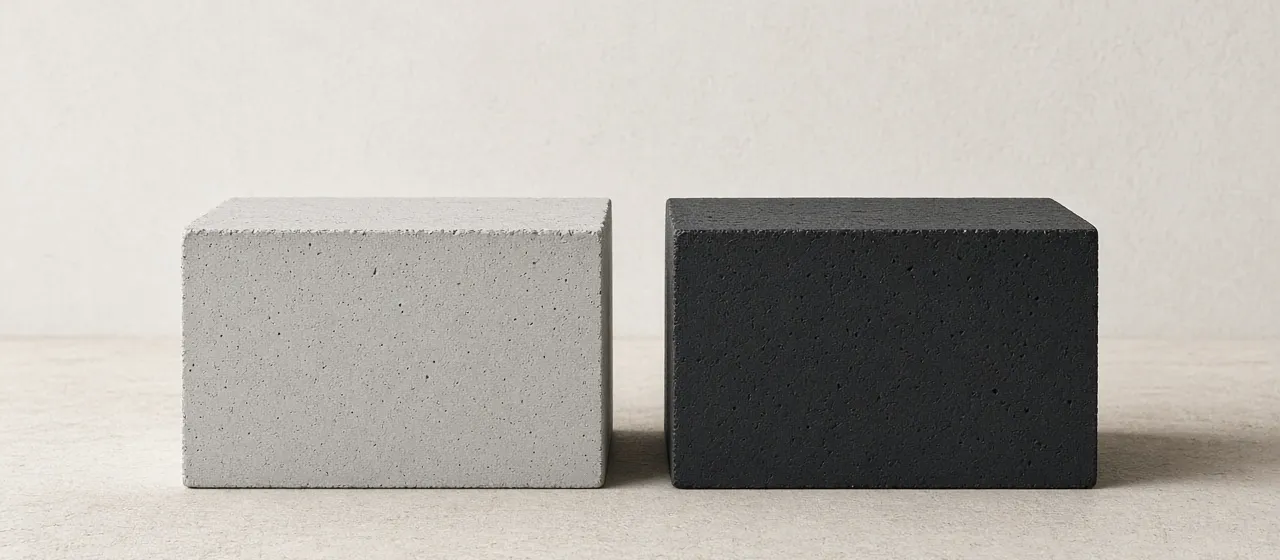
Grey cement has its own dark base colour that mutes and darkens the pigment, giving earthy, muted tones. White cement gives lighter, cleaner colours, because the colour of white cement is controlled in production. It is often used for yellow, red and light tones.[1]
That is why every FerroSpire product is shown as an indicative sample in both grey and white cement. A physical 5×10 cm sample can be ordered – you decide what you want when you order, and we make exactly that. Order a sample →
PCE superplasticisers and black iron oxide
PCE (polycarboxylate ether) is the most common superplasticiser in modern concrete, especially self-compacting concrete. It adsorbs onto particles in the cement paste and keeps them apart, so the concrete flows with little water.[5]
With black iron oxide this can, in some cases, cause two unwanted effects: the pigment agglomerates, so the colour is paler than expected, and a white deposit may appear that looks like efflorescence but cannot be removed with acid. Trade articles describe this as a minority of cases, and it concerns black iron oxide, not red or yellow pigments. The more PCE and water, the higher the risk.[2][3]
What you can do
- Make a trial cast with the same cement, PCE and pigment as in production.
- Try a different PCE type or cement if black turns pale.
- Use liquid pigment instead of powder.
- Avoid more PCE and water than necessary.
FerroSpire Black and PCE
We are happy to test FerroSpire Black with the PCE product you use: send us the PCE product, and we will arrange a test cast. Contact us → · Order a sample →
Efflorescence and moisture
Not every white deposit is caused by PCE. The most common is efflorescence (calcium carbonate). It occurs in all concrete but is most visible on dark concrete. Efflorescence does not weaken the concrete and can be removed with mild acid.[4]
Efflorescence is more likely when there is moisture on the other side of the concrete and the moisture can pass through it. Good drainage is therefore important.
Pigments for concrete
FerroSpire pigments for concrete, ordered by family. Pails (net 24 kg); big bags and IBCs (1 tonne) by arrangement.
- Black4 products
- Red6 products
- Yellow5 products
- Orange2 products
- Brown1 products
- Violet and magenta2 products
- Green2 products
- Blue4 products
- White1 products
Order a sample
See the colour before you decide. We send a physical 5×10 cm sample, made exactly as you order it.
Sources
- C. Higgins: «Coloring Concrete Bridge Components with Pigments for Integrally Colored Concrete», 2004 Concrete Bridge Conference (PCI)
- BFT International 02/2014: «Unwanted interactions between black iron-oxide pigment and PCE-based superplasticizers»
- BFT International 07/2024: «New concrete technologies and color pigments»
- InformationsZentrum Beton: Zement-Merkblatt B 27 «Ausblühungen» (1.2013)
- Zingg m.fl.: «Adsorption of polyelectrolytes and its influence on the rheology, zeta potential, and microstructure of various cement and hydrate phases», J. Colloid Interface Sci. 323 (2008)
Relevant standards: EN 206 (concrete), EN 934-2 (admixtures) and EN 197-1 (cement).
FAQ
Frequently asked questions
How much pigment do I need in concrete?
Typically 2–6 % dry pigment by weight of cement, but the dosage depends on the desired colour, so talk to us and order samples.
Why do I need more liquid pigment than powder?
Dosages refer to dry pigment. In liquid pigment the rest is mainly water, so you need more liquid pigment for the same amount of pigment. The pigment content is stated on the technical data sheet and on the label.
How is liquid pigment added?
In three ways: with a dosing system, by pouring the liquid pigment from the pail into the concrete mixer, or by pouring it straight into the truck mixer. Adding it in the truck means the plant mixer does not need washing and can be used for other pours straight away, with no downtime and no risk of contaminating the next pour.
Why does liquid pigment distribute more easily than powder?
In liquid form the pigment is already dispersed, so the colour spreads through the wet concrete as it is mixed. Dry pigment powder is agglomerated and needs the shear forces generated when the dry materials are mixed, before cement and water are added.
What is the difference between grey and white cement?
Grey cement has its own dark base colour, which mutes and darkens the pigment. White cement gives lighter, cleaner colours, especially for yellow, red and light shades. Black performs well in both.
Can PCE superplasticisers affect black iron oxide?
Yes, in some cases. Trade publications and pigment laboratories have documented that certain PCE superplasticisers can cause black iron oxide to agglomerate, so the colour becomes paler, and that a white deposit may appear that cannot be removed with acid. Only black iron oxide is affected, and according to the sources only in a minority of cases. A trial cast reveals it.
Does FerroSpire Black work with PCE?
We are happy to test FerroSpire Black with the PCE product you use: send us the PCE product, and we will arrange a test cast.
What can I do if PCE makes black concrete pale?
The sources recommend trying another PCE type or cement, using liquid pigment instead of powder and avoiding excess PCE and water. Always make a trial cast with the same raw materials as in production.
Is a white deposit on black concrete always the PCE effect?
No. The most common cause is efflorescence (calcium carbonate), which occurs in all concrete but is most visible on dark concrete. Efflorescence can be removed with mild acid and often fades over time. The deposit from the PCE effect contains ettringite and cannot be removed with acid.
What makes efflorescence more likely?
Efflorescence is more likely when there is moisture on the other side of the concrete and the moisture can pass through it. Good drainage is therefore important.